 07851 829791
 info@francescafrancistherapy.co.uk
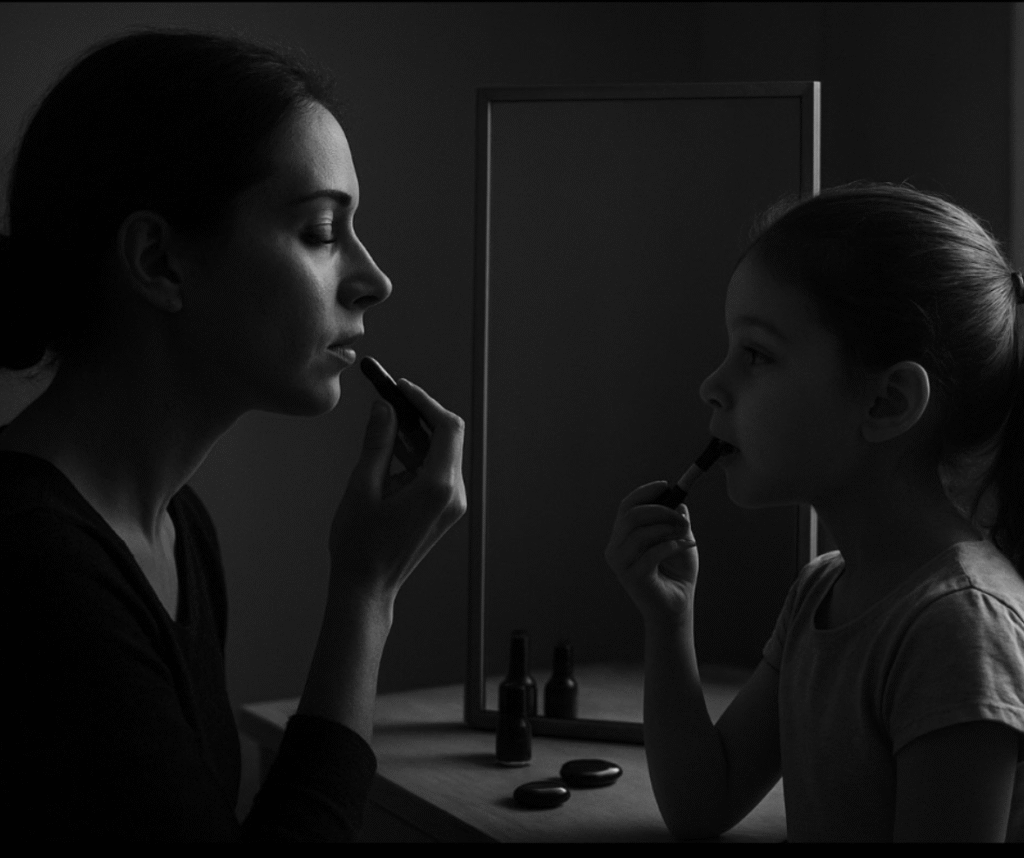
When Little You Enters the Room
As we grow up, we are often gifted with a digital diary — old clips and photographs of ourselves, quietly gathering dust in the corners of our devices. Forgotten fragments of who we once were. As we navigate life, these clips rarely play… until something shifts.
Sometimes, in the space of therapy, a clip begins to play.
It’s not a memory in the usual sense, nor a dream. It is Little You — the child in the photograph, stepping out of the screen. A smaller version of yourself, holding the weight and wonder of who you once were. She enters quietly, carrying the light and softness of moments you had thought lost.
As children, photographs were often taken for us — snapshots of moments chosen by others. Now, we take them ourselves. Our phones have become mirrors of control: we choose the angle, the filter, the frame. We decide how to capture ourselves, as if we can control our feelings the same way. But the images in our digital diaries remind us that some parts of ourselves have always been without a pause button.
As adults, we often pause if we see an uncomfortable clip from our childhood. We might look away, avert our gaze, or tuck it away again. But therapy does not have a pause button. It offers something different: the space to bring your youngest self into the room with you.
It takes consciousness to acknowledge her. She doesn’t arrive with words. She comes through gestures: the nervous twist of a ring, the way you laugh to cover discomfort, even the shade of lipstick you still choose — echoing the child who once painted her face simply to see what might happen.
She lives inside you, quietly, waiting to be recognised.
The hidden companion
Little You carries your earliest stories: joy and wonder, but also doubt, fear, and longing. She remembers what it felt like to be overlooked, to shrink so others could feel comfortable. She remembers the thrill of pretending — experimenting, imagining herself into something new.
When you step into a counselling room, she enters too. Not as a guest, but as part of the conversation — the part you might not have realised was there until the clip began to play.
The vanity as a mirror of self-worth
For many of us, the vanity was our first mirror. Not just of faces, but of identity. It held our first rehearsals of who we could be: smiles to mask cracks, poses to hide insecurities, colours to perform a version of ourselves that felt safe.
Our digital diary carries the same mirror. Each photograph, each clip, becomes a rehearsal — rehearsals we return to without realising.
When Little You enters the room now, she may still carry her vanity beside her and a clip softly playing in her hand — edges faded, sound hushed by time. Without words, she asks: Will you see me beneath the layers?
Sitting at the vanity again
Counselling offers a rare space to return to that vanity — not to disguise, but to remember. Not to perfect, but to reconnect.
• Dusting away what was neglected. • Seeing cracks without shame.
• Adding colour again, not for others, but for yourself.
Sitting at the vanity again becomes a metaphor for self-worth: the act of consciously acknowledging the child you still carry, and caring for her as she always deserved.
Two selves in one room
Healing begins when you allow both selves to share the space — adult you with the weight of responsibilities, and Little You, the child from your digital diary, quietly sitting at her vanity.
Because the truth is this: you are not broken. You have simply forgotten that she is there, quietly waiting for you to notice her and give her space.